

The glass bottle reuse sector is gradually taking shape, but its economic stability remains fragile. What measures can be taken to improve its sustainability, and what financial support is needed for its development?
To shed light on these issues, Léko has published a study on the economic viability of the glass bottle reuse sector, based on data collected from various stakeholders in the loop and on a forward-looking model projecting to 2035. This approach combines feedback from the field with quantitative analysis to better understand the costs, operational constraints, and conditions necessary for scaling up.
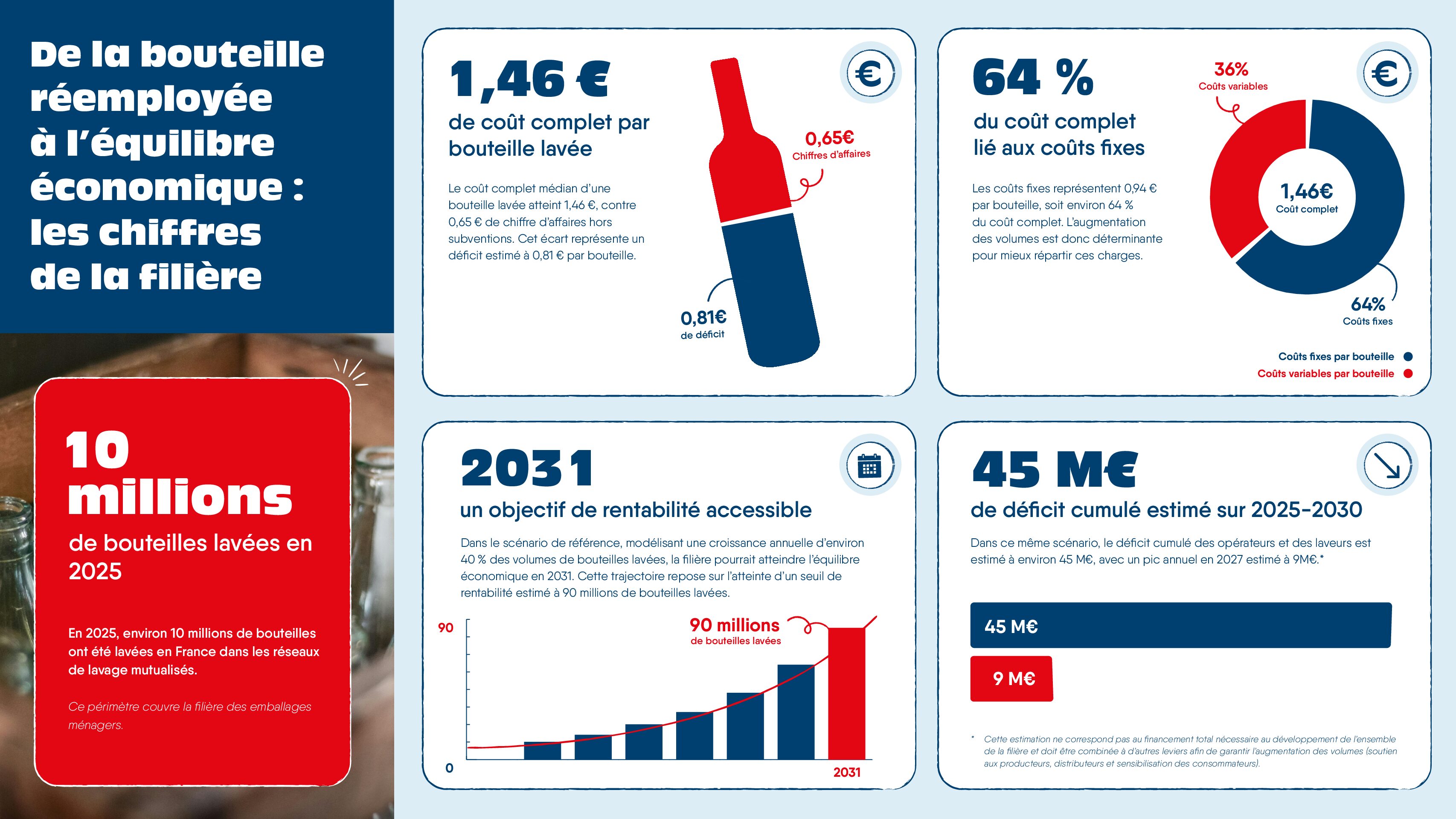
Higher volumes to achieve profitability
The study highlights the central role of volume in improving the economic viability of reuse. An increase in volume allows fixed costs to be spread across a larger number of bottles, but it is also an essential condition for reducing variable unit costs. Larger and more consistent flows make it easier, in particular, to optimize collection routes, fill vehicles to capacity, and utilize washing lines.
Volume growth and productivity improvements must therefore be pursued in tandem, by engaging all stakeholders in the process.
Prompt support to help the industry reach a new milestone
Profitability is within reach, but the industry needs financial support quickly to take this next step.
The transition period remains challenging for operators and car wash facilities, which must bear significant fixed costs before reaching a sufficient level of business activity. Without appropriate support, some operators may not be able to stay in business until volumes and productivity gains allow them to consolidate their business model.
Three key factors appear to be essential to support this transition:
Accelerate volume growth, particularly by engaging producers, distributors, and consumers.
Fund the investments needed to develop the capacity for collection, consolidation, sorting, and washing.
Temporarily subsidize operating costs to enable operators to get through this difficult period until they reach financial stability.
The challenge is not to provide long-term funding for a deficit, but to give the industry the resources today to become economically self-sufficient tomorrow.
A study that supports Léko's proposal for nationwide deployment
The results of this study also inform the proposal for nationwide deployment developed by Léko. This proposal outlines funding recommendations through 2031 to support the development of the sector as a whole and create the conditions for its economic self-sufficiency. It thus identifies four complementary pillars to be supported: reuse operators (the focus of this economic study), marketers, distributors, and consumer awareness.
View the detailed summary of the study
Learn about the current economic landscape of the industry, the modeling assumptions, the forward-looking scenarios through 2035, and the proposed strategic directions to accelerate the growth of glass bottle reuse.